Sunday, 6 January 2013

13 Insights into Happiness for 2013 (pt. 2)

As promised, the eagerly awaited follow up to last week's post.

7. Thinking strategically about happiness


If several years back someone had told me that I should apply insights from the world of work to how I live my life, I would have probably replied "go back to management school or America or your self-help blog and leave me alone". However, I am now about to advocate the very same insight. Working in finance / investment over the past three years has given me some exposure to what makes a good investment and some of that, for better or worse, pervades my thoughts on life and happiness. In particular, I now try to apply the following:

(i) Work learning: Using data and research to inform your budgets, plans and forecasts. 
Life lesson: Using data and research to inform how you plan and conduct your life to sustain happiness.

Budgeting, planning and forecasting are very time consuming activities, and often require either a prerequisite level of experience or technical expertise. When it comes to happiness,   there is no good reason not to apply the wisdom acquired through the ages and now, more excitingly, we have actual data on well-being and brain science. These reports by nef amalgamate some of the academic literature that analyses well-being statistics and summarise findings from the UK in the last year. Findings that have helped for me, for instance, are the near universal correlation between commute times and unhappiness (LH has since changed jobs in part due to this) and the U-shaped relationship between age and happiness - we tend to hit a trough in our 30s and 40s which is usually linked to raising children, taking care of parents and peak stress levels at work (it might help to start thinking about such things early!).

Other great sources of insight are the Action for Happiness website and understanding your own genetic dispositions - as they can determine up to 50% of your base level of happiness. In 2013 I am going to continue to analyse genetic studies that and see what they mean for my genetic material at 23andme.com.

(ii) Work learning: Think about risks as much as you think about your base case. 
Life lesson: Mitigate risks that are in your control, and build resilience so you can deal with things that aren't.

Risk-return is a bit of paradigm in the investment world, but it may seem a little boring / overly practical in the real world - I mean who really wants to do a risk assessment on their life and happiness levels? Thankfully, in the developed world, there are a lot of things that "automatically" protect us from bad external events (such as natural disasters, economic crises and decline, violence, illness) impacting our hedonistic happiness (remember this includes the absence of pain too). Examples of these automatic protections include property rights and policing (stopping people from taking our stuff), welfare, health insurance, the family unit, charity (e.g. Red Cross), democratic institutions (including a free press that allows us to highlight pain and suffering), environmental agencies and insurance markets. There are benefits to be had if you can force yourself to do a bit of planning in this regard too, e.g. making sure you have adequate contingencies, savings, insurance etc. As boring as they may seem, they probably do make your happiness more sustainable in the long run.

There are, of course, always things you cannot control - for consideration on that issue see my point on resilience below.

(iii) Work learning: Returns can be delayed - the amount you are prepared to wait is in part determined about how you value time. 
Life lesson: Understand what your time preferences are.

Some people can delay gratification for long periods of time in order to get a big chunk of gratification at the end (e.g. a medical student going through many years of training in order to obtain a job as a doctor). Others have shorter time horizons after which they need gratification. To some extent, you are who you are and you should explore what your preferences are but, at the same time, improving your will power can benefit you without causing you to be unhappy in the short run. Either way explore! This talk on willpower by Roy F Baumeister provides some really interesting insights.

8. The importance of being resilient


2012 cemented in my mind something I had being doing for many years but had never formalised - namely building emotional and mental resilience. Some would refer to this as the application of Stoic philosophy. In simple terms, I deem it the preparation of your mind for a variety of unexpected scenarios. In doing so you figure out, in advance, how you would derive happiness in an unexpected world (e.g. after the loss of a loved one, losing a job, winning the lottery, becoming disabled, being misunderstood). In 2012, I came across the work of ancient greek philosopher Epictetus and two quotes continue to stick with me (i) "It's not the [bad] event, but the belief ascribed to the [bad] event that troubles man" and (ii) the advice that man should be "sick and yet happy, in peril and yet happy, dying and yet happy, in exile and happy, in disgrace and happy". The difficulty is, of course, in doing these mental preparedness exercises and, for me, there are no hard and fast rules of success, except perhaps the willingness to indulge in some pretty morbid feats of imagination!

For me, the importance of the above is to prepare without allowing preparation to get in the way of progress. Yes you can adapt to being slightly cold, or slightly hungry, or slightly disillusioned, but you should still aim to correct all these in the long run. If misfortune means you end up in these situations then, and only then, take it into your stride.

9. Should well-being be taught in schools?


In 2012, I learnt that Wellington College (an independent, boarding school in Berkshire) has been teaching its pupils about well-being. This is a fantastic idea, and I would like to see it spread right across the education spectrum (especially the state sector). Education's purpose, in my mind, is simply to (i) give people the aptitudes required to take part in the productive economy and (ii) give people the knowledge and skills to lead a happy life. Somehow, we seem to fail at both and, even though this blog is mainly interested in (ii), for now I will be exploring how this can be improved only alongside (i).

In 2013, I will learn more about what Wellington has achieved by going through their course online, will read Learning to Ride Elephants by Wellington well-being teacher Ian Morris and hopefully I'll be placed as a school governor.

10. The Existential Crisis - and why society seems to do nothing about it


A thought hit me in 2012. I can occasionally lurch into a full blown fit of existential crisis - usually a bout of apathy and soul-searching brought on by a series of questions / revelations: "what's the point?" "why am I here?" "death is the only thing we have certainty over" etc etc. I have got better at dealing with these, but they still exist. For all the wonderful improvements in society, however, this seems like a universal problem that secular society has decided to universally ignore (or at least say it is the problem only for the individual). Libertarians would argue that's right, because philosophy and spirituality are personal pursuits in the West. 

However, I believe that the state or other parts of society have good reason to act where it can be shown to improve well-being. Examples of this, as yet unproven, are the introduction of rights to optional sabaticals / mid-career breaks and the beginnings of well-being education in schools (for more inspiration I would suggest Norwegian philosopher's Zapffe's "Last Messiah"). Further argument on this is provided by Alain de Botton in his book Religion for Atheists (or listen to the TED talk here). The central question explored is that, in a world where organised religion is retreating, where do we get our rituals and our spaces for connection and exploring the "big" questions from?

In 2013 I will be exploring whether policies or solutions could work - ideas welcome!

11. Development as Happiness


In 2012, I revisited Amartya Sen's seminal work on how we should frame international development, "Development as Freedom". One strand of the argument is that we should frame development as the increasing of individual freedoms and removal of societal unfreedoms whether they are economic (e.g. poverty), political (e.g. state control) or social (e.g. women's rights). As a book and theory I find it very hard to poke any holes in Sen's work as it is well researched and for a predominantly economics-based book, steeped in humanity and human values. However, at times (day-to-day) I do struggle with the way the argument is framed - I cannot relate to the idea of lack of freedom because I've never experienced it. But I can relate to happiness - and I think this is how we should frame development. At first reading, this may seem very woolly and western - what has happiness got to do with a starving child or torture. But, as my definition of happiness goes, it is all one spectrum; from pain, to comfort to release of anxiety to pleasure, self-realising and flourishing. Indeed, I previously used to think of happiness as a problem faced by only the developed world and other issues, e.g. poverty and repression, as problems of the South. Now I think we should see it all as part of the same issue.

And why? It's not exactly going to solve the issues is it? My answer is this - how issues are framed can have very profound effects on how people engage (as argued by Kahneman for instance). Understanding development as a universal search for happiness (more tangible than freedom) may be a more effective way to engage with the issue and to, therefore, go on to develop solutions.

12. Solitude and Mindfulness


In 2012, I took a great 3 day retreat to the Gladstone Library in Hawarden, Wales. My lesson learnt was simple: time away for reflection and solitude can be very important for de-cluttering your thoughts and reducing anxiety - so do it!

And I would recommend a stay in a library to anyone who is similar minded!

13. There's no such thing as a selfless gift..


.. and there's nothing wrong with that! It is shown that giving increases the happiness of the giver and receiver (if effective). I won't go into the evidence of why, as this resource is already a pretty good starting point: action for happiness on giving. Whilst we all tend to know this, one thing that stops us giving is that we are mentally unprepared - to the Big Issue salesman or to a friend or family who's indicated they have some difficulty coming up. Recently, LH changed jobs from the for profit sector to a not-for-profit (in fundraising). When asked what she learnt from this at a personal level, it was that most people tend to start with the mentality of "no" when asked for help and then try to justify why "yes". This can be taxing and means that we give less often than we expect we would. In 2013, as per this TED talk from the Acumen Fund, I will start with the mentality of "yes" when asked to help!

Tuesday, 1 January 2013

13 Insights into Happiness for 2013 (pt. 1)

I have spent some time away from the blog to explore and consolidate some of the ideas I explored earlier last year. Here are some things I picked up in 2012 that have given me greater insight into happiness (both at a personal and societal level):

1. The Examined Life


"The unexamined life is not worth living" (Socrates). For me this is not quite right, but there is something to gain from this. A six week ancient philosophy course at the Idler Academy, gave me and Lady Hamster (LH) an insight into how ancient Greeks and Romans put a great emphasis on exploring what it was to live a good life, a happy life. Socrates, Plato, Aristotle, the Epicureans, the Stoics, the Cynics and the Sceptics all had differing views on what the constituent components were. However, what they all had in common was their desire to explore what it was to be alive, what it was to be happy and what it was to be good. I believe that exploring the world around us (the external) and how we make sense and act in it (the internal) is just a very sustainable and cost-effective way of keeping us happy. I'm not sure what the arguments against are(?).

2. Challenging Consumerism


There was a running theme at the Hay-on-Wye literary festival in 2012 - we need to challenge the Western (mainly US/UK) culture of consumption. The message came from Philosophers, Economists and Environmentalists alike. 

My interest in happiness started when I found out about the Easterlin Paradox, in part linked to the idea that we are all stuck on this hedonic treadmill, constantly trying to keep up with the Joneses. But this way of life is self-defeating; if we constantly look to the next hedonic high or to how we are doing relative to others, we leave very little time to achieve genuine, sustainable wellbeing. In 2013, I will make baby steps towards addressing my consumption habit by following this manifesto.

3. The Homogeneity of Hedonism


"Live life for now, f*** tomorrow, yeah". That's what hedonism is in essence about, but why have we become so boring in the way we achieve it? 

In my world of happiness, hedonism (when it is sustainable) has a very real place. Hedonism is the avoidance of uneccessary pain and the seeking of simple pleasures. An overly virtuous life where pleasure is resisted and suffering is borne cannot be a happy life.

In 2012, I became a little disillusioned with how we go about hedonism today. The term is synonymous with festivals, drug taking, binge drinking, thrill seeking and clubbing. Whilst I do not dispute that these work for some (and critical mass can be important), I cannot believe these are the most effective / sustainable approaches for all. Pleasure is very much a personal experience, and there is lot to gain from exploring it as an individual rather than buying into the packaged "experience" sold by everyone from drinks promoters to desserts. A favourite character of mine in the Ancient world is Diogenes of Sinope - a philosopher who made a point of rejecting the crowd. In 2013, my nights will include my key components for hedonistic pleasure (good conversation, culinary concoctions, comedy, debate, silliness, exploration of ideas and gratuitous nudity
(?))

4. Remembering vs. Experience


This TED talk by Daniel Kahneman definitely changed the way I thought about hedonic pleasure. In the talk, Kahneman describes two generalisable mental states - our experiencing selves and our remembering selves. This should not be a surprise - how we think about things we are doing right now and how we think about things in the past are subtly different. But the implications for happiness are interesting. Whilst a string of positive experiences (e.g. great meals) can be a good thing, they are not enough to sustain happiness (we cannot simply sum up all our food experiences and say the aggregate is our increased happiness). However, the memory of these experiences (past great tastes and flavours) has been shown to activate the parts of our brain associated with pleasure and happiness. It is often the memory of a thing, rather than the experience, which is more important for our happiness.

Now, of course, a simple rebuttal goes like this: a life lived for the benefit of posterity is no life at all - how would we ever live in the moment and enjoy life? My personal take is this: do live life in the moment, but take into account your future self. Your future self, for example, will not benefit from you getting blind drunk to the point you forget. Examples of my approach for 2013 are to continue to take pictures of food, especially tasting menus and not to be afraid to work hard; your future self is bad at recollecting certain mental pains!

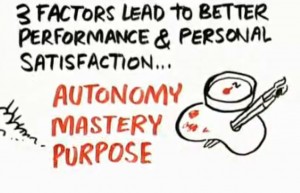
5. Mastery, Purpose and Autonomy


This TED talk by Dan Pink introduced me to the idea that, outside of income, there are three things we tend to look for in the world of work and more widely. These are (i) mastery (being good at the job), (ii) purpose (believing that what we do is worthwhile) and (iii) autonomy (being in charge of our agenda and, therefore, ultimately our levels of stress). Viewed through this lens, it became easier to make sense of my current job and my career path. For instance, I was able to understand that some of my current frustrations at work were down to a lack of mastery and autonomy, which may improve as I gain experience and build trust. I know I do not derive any purpose from my job and so I know that, in order to be happy, I will need to change career paths at some point. For each person, how much these things matter will differ, but the understanding ought to be useful.

The societal impact is also profound when we start to think about how to create a happier society. Should we re-evaluate the importance of income in motivation? Do all jobs allow us to achieve these elements? If not, do we change the nature of jobs? Or do we think about how people can achieve these things outside the world of work? Should we sacrifice more for full employment - as the workplace may be the only place where we can effectively achieve mastery, purpose and autonomy?

6. Connectedness


This is, in my mind, a self-evident idea. Having healthy, strong relationships and connecting on a regular basis; whether this be with family, life partners or friends is self evidently good for happiness. It allows us to verify our existence, partake in mutually beneficial activities, explore ideas, share life's burdens, confirm our altruistic nature and receive/give recognition, comfort and love.

One of my big disappointments in 2012 was that many of those close to me did not prioritise this source of happiness. Building strong relationships involves creating good "quality time". We all live busy lives so, in 2012, I gave serious though to events and spaces where I could connect with friends and family but people weren't able to make the time. My aim for 2013 is to continue with my perseverance and I am looking forward to revisiting some excellent memories in 2014!

Saturday, 30 June 2012

How austerity could help our generation


I am of the view that our economic situation in Britain is pretty dire; probably worse than the picture being painted by our increasingly pessimistic government. As this report by city brokerage Tullett Prebon outlines, the government's plans to eradicate the budget deficit by 2016, rely on rates of growth seen under the last administration of c.2.8%. This level of growth came on the back of a debt-fuelled spending boom in construction, real estate and government spending. Since the financiers of these boom - the government, financial institutions and individuals - are in no longer in a position to borrow, it would probably be fair to say we cannot rely on growth in these sectors. Without them, as argued in the report, trend growth levels were probably more like 1.4% in the boom years, meaning the OBR is probably being optimistic in its 2016 targets. Given this context, austerity, or variations on austerity, remain prudent options whilst we sort our finances out. Yet the left refuses to accept this notion (apart from maybe these guys) - wedded to an idea of growing our way out of this situation. Instead I believe the left need to start thinking seriously about a Britain facing declining living standards, and how they can embrace austerity for the benefit of my generation.


Opportunity 1: Future generations do not have to suffer

Let me start by saying I am not denying that people are suffering. Austerity has already had many serious consequences for young people - youth long-term unemployment has risen by a staggering 874% since 2000. Ideally there would be no need for austerity. In a globalised, open, free-market economy, economic cycles are a fact of life. However, the state can buffer individuals from changes to a world that they have little control over. Yet we have not had this. The fact that no credible, fundable expansionary policy was available at the end of the New Labour era is a critical and damning failure. Simply put, whilst the global economic crisis was not New Labour's fault, the need to resort to austerity is. This period of austerity should not be forgotten - our public sector workers and young people should be protected from worst of economic cycles in the future.  We can do this by promising less, actually adhering to our fiscal "golden" rules and anti-cyclical fiscal policy and developing state capitalist institutions that can lend when we need them to (e.g. in the form of a Green Investment Bank or a National Investment Bank such as Germany's KfW).

Opportunity 2: This is our chance to tackle consumerism

The Labour opposition congratulate themselves on coining the term "the squeezed middle" - hard working, middle England who are "suffering" from inflation, wage freezes and cuts in public spending. But we have to be careful; careful to distinguish what for some is a radical life change, but for the majority is nothing more than a squeeze on their consumerist way of life, and not on their well-being, happiness or life satisfaction. I say this often, but will repeat it again. Ours is a consumption lead, debt-fuelled economy. The big elephant in the room in Western societies is that they are no happier despite rising levels of income since WWII. Research shows that 
  • people who have materialist values are no happier
  • the riots appear to have strong links to consumerism 
  • people who engage in civic activities, volunteering and spending more time with friends and family are happier 
  • inequality may make people unhappier and 
  • the effect of unemployment on happiness is greater than the impact from loss of income. 
In my mind, these conclusions are the bedrock of the left, but often get put aside by the "important" issues of growth and standards of living. Austerity is our chance to tackle these entrenched ideologies.

Further, well-being is not the only reason to tackle consumerism. Investment is ultimately delayed consumption. If no-one is delaying consumption, there is no money to invest. One group who does delay consumption are the savers in the East (India, China, Middle East) who ultimately invest in the UK. If they start to consume at similar levels to us, our sources of funding will dry up. We need a sustainable source of people delaying consumption or we will not be able to invest in our future. What's more with our rates of consumption today we might not have a future - planetary resources place a hard constraint on infinite consumption.

This is an opportunity for the discussion on happiness to start (people look inward in perceived tougher times). The gradual demonization of GDP growth as a measure of society’s progress is an important step in implementing progressive policy for future generations. What's more the policy ideas are already out there, below I present a few ideas:
  • a progressive consumption tax
  •  bans on advertising,
  • proper paternal leave,
  • no-opt out of the 48 hour working week,
  • statutory sabaticals  
  • reform of government cost-benefit analysis and bolstering of the social value bill
Opportunity 3: Let's build policy around our squeezed generation that now, not later

Our defence of the squeezed middle seems futile – the issue is on-going and not limited to this period of austerity. Our generation will, or already does, faces issues of:
  • student loan repayments
  • increasing pension costs,
  • increased costs of caring for our elderly,
  • shortages of housing stock
  • global inflation - to name but a few sources: increasing wages in the BRICs, geo-political led fossil fuel price volatility, resource depletion, new demand-led inflation from the growing middle classes of the BRICs
  • mass redundancy of the low-skilled due to outsourcing
  • increased competition in high-skilled jobs due to rise of the middle class in the BRICs
  • green taxes - and worse still if climate change does occur, this squeeze will be even more dramatic
  • the cost of renewing our ageing infrastructure
The left need to get used to this and think of policy that is useful. Policy needs to pursue happiness not consumerist growth – only a squeeze on well-being being should be of concern for policy makers. We need to sow the seeds of bringing back low-skilled jobs (e.g. digital, low-tech manufacturing, urban agriculture, the green new deal) that mean we will be less at the mercy of a globalisation squeeze. Finally, we need to create sustainable housing and infrastructure with an emphasis on national and local self-sufficiency.

Opportunity 4: Let's start the debate on the big trade-offs

New Labour dumbed down the idea of a trade-offs in achieving a more equal society – austerity has put it back on the agenda. We were lead to believe that we could re-distribute without pain because we could grow forever and cheap finance could always act as a bridge if we were profligate. This was a lie - you cannot sustainably use debt to fund current expenditure. Yet on the left we do believe in an equitable re-distribution of income. Now is the time we need to talk openly and forcefully about how this is funded, whether this be via higher universal tax rates, progressive consumption taxes, taxes as market corrections or taxes on wealth.

Opportunity 5: Let's reform the state to better meet our objectives in this changing world

Austerity and cuts undermine the big state - but the large state is not necessarily the bed fellow of the left. Let’s assume the left believes in the progress of the worst off - the poorest, the unhappiest - and collective actions to ease individual misfortune - shocks that impact wealth and happiness. These principles do not have to be delivered by the state, though still noting the desire to fund such action via progressive, central means. In the light of austerity, the next generation has the ability to do things more effectively. Many reforms are more to do with effective governance and local action e.g. co-operatives, mutuals, "big society" - all movements that the left can identify with. Action can also benefit from an emphasis on upstream prevention (e.g. fighting obesity) rather than the safety net (e.g. treating diabetes, heart disease). Social impact bonds are structured on the basis on upstream projects that lead to downstream savings. At the same time, this does not prevent a strong state providing strong market intervention, national infrastructure and a buffer to the global economic cycle.

Opportunity 6: Let's think about where efficiency is welcome

Austerity has lead us to think long and hard about areas in which we can achieve efficiency gains - these changes have the impact of being both expansionary and lasting for generations. Let us use this time to embrace efficiency where it useful. Examples in action today include the Green New Deal, upstream prevention, smart meters for our energy networks, and procurement reform e.g. alternatives to expensive PFI schemes. At the same time, there has to be a real acknowledgement on where efficiency is not welcome - is there such thing as more efficient patient care? Or more efficient social work? The only way the left can lead these debates is by engaging in the first place.


Many in our generation will face scars from this period of austerity, from long-term unemployment, a slower economy and reduced key public services. However, it should be seen as an opportunity for the left to re-invigorate rather than protest. In my mind, at the heart of this movement would be:
  1. Prudent, anti-cyclical future fiscal policy (admitting economic cycles are a fact)
  2. Bringing well-being to the forefront of policymaking
  3. Planning for the squeeze by investing in a self-sufficient, sustainable economy
  4. A serious conversation about how to fund re-distribution
  5. Using austerity to reform the central state machine
  6. Using austerity to push through efficiency, but only where this is humane


Sunday, 27 May 2012

Should our politicians be serious about happiness? pt. 2

In my last blog, I set the context in which a "new" science and philosophy of happiness was gaining traction amongst a wide range of individuals and schools of thoughts. The blog ended with the question of why it was our politicians seemed to be the last group willing to talk seriously about the issue. This blog will explore some of these reason for this reluctance, and suggest some practical reasons why it does not need to be so:


(1) Happiness is a vague, subjective, fuzzy term - it doesn't deal with real issues faced by real people


This complaint seems to confuse means with ends. Why is it that we seek to prevent unemployment, poverty, crime and poor health? It is not enough that these are inherently bad things, it is the fact they adversely impact individuals: how they feel and how satisfied they are with their lives as a whole. In these cases it is not the objective, intermediate measure (unemployment, a low wage, facing a crime, a disease) that is the bad, but the interaction between these facts and the subjective impact that they have on an individual (psychological burden, hunger / stress, pain, feeling awful) that matters. 


This distinction may feel a bit futile, however targeting happiness not only deals with the real issues, but it has the potential to do so in a more targeted way that brings about more effective change. Point 2 looks at this in more detail.


(2) Everyone, including politicians, is already trying to promote happiness. Instead of wasting their time on a "happiness agenda", politicians should spend their time on the detail and nuts of bolts of making sure government is run efficiently, intelligently and fairly.

It is true that in the developed world. political and economic policy over the last few centuries has improved well-being - we can look at agricultural policy, welfare, universal health and education provision. However, more recently (post-war period) policy has been pre-occupied with these intermediate goals rather than more direct ones. No amount of technocratic competency will get you to where you're going if you have no target destination.  


Take unemployment. In traditional macroeconomics, unemployment is a trade-off we face with inflation and productivity. We tend to focus on systems that have a healthy balance of all three items, arguing that low inflation (less of the "squeezed middle") and productivity (potential income growth) are also desired by people and hence we tolerate some unemployment. This is true under a  neo-classic economic framework where higher consumption over time is equated with better life outcomes. This is where subjective happiness really comes into its own. The Easterlin paradox remains true as it ever was. Increases in income over time in developed countries have negligible impacts on happiness. Any effects that do exist tend to tail off at higher levels of income. What's more, people with materialistic values tend to be unhappier. 


A happiness agenda is not what currently drives our politicians. A more efficient, intelligent and fair thing to do would be to take it seriously.

(3) Aren't some of the recommendations anti economic growth? Doesn't happiness now mean misery tomorrow?

Yes they are. Some of the stylised facts of well-being research (see nef publication) - lower hours, more time with friends and family, higher utilisation of labour, more equal wages, lower levels of leverage, a more rounded education all have very serious anti-growth implications. But we do not need to worry about these. The neo-classical theory of income and consumption as a measure of well-being simply falls short. GDP as a measure of society's progress is out-of-date and potentially harmful. Unemployment, on the other hand, is a real happiness issue and we should think of ways to ensure full employment in a low / no growth environment. 


This is no easy task, but some interesting ideas have come from a happiness school of thought. For instance, how about sharing work hours? Is it not strange that we live in a world where our parts of our workforce are simultaneously over-worked and under-worked. 

(4) There is not enough good quality, reliable data for this to be a serious policy tool. 

This is not true - surveys with large samples sizes have been probing people about their subjective levels of well-being since the 1970's and 80's for instance the US General Social Survey, the European Values Survey and the British Household Panel Survey. These have produced useful academic insights - see here for a review of studies to date. What's exciting is that new surveys are being commissioned by large national and international bodies, such as the UK's Office for National Statistics, the OECD and a new body commissioned by FrenchPresident Nicolas Sarkozy and headed by economist heavyweights Jospeh Stiglitz and Amartya Sen. Subjective well-being measures are bound to make a bigger impact on policy making in years to come. 

(5) The state should have nothing to do with people's happiness. People are happier when state is not involved in their personal choices.

People are unhappy where their freedom is restricted and a nanny state is in place - just look at the failure of societies that have tried to organise themselves for the greater good e.g. Soviet Russia. But this is precisely the point - any state that seriously cared about happiness and the happiness of their population would not advocate such restrictions of freedom. The evidence to date displays two stylised facts: (i) trust in key public institutions – for example, government, the police and the legal system – is associated with higher life satisfaction and (ii) there is a positive association between democracy and life satisfaction. 


A trusted, well-functioning and representative government tends to make people happier. But this does not mean the state should not do anything else. The government not only needs to ensure that it governs institutions that people can trust and defend democratic principles, but also has the duty to pursue collectivist actions that undoubtedly makes us happier. Policies exist today, but can be improved, whether they be economic policy that delivers full employment, state backed healthcare or welfare expenditure. The evidence suggests that higher public spending and benefit entitlements appear to be associated with higher well-being at the national level (although these do need to be sustainable).


Of course, the balance of government intervention and individual freedom is something that has been discussed for several millennia and it is not the place to discuss here. However, simply stating that politicians should not at least think about happiness seems odd when the state has the potential to significantly improve our happiness.

(6) This is all a bit woolly - what does it mean in reality for policy?

Policy is a minefield, with lots of vested interests (often driven by power) pulling the strings at any one time. However, with a strong evidence base, happiness has the ability to really drive policy that improves all our lot. The data so far points out (I select a few excerpts):

  • Unemployment has a detrimental impact on a person's happiness that outweighs the loss of income
  • The relationship between income and happiness over time in developing countries is non-existent or at best weak. 
  • People are however, concerned about relative income (comparing themselves to their peer group)
  • Good health is strongly related to happiness
  • Divorce or separation strongly negatively impacts on happiness
  • Whether the level of inequality in a society affects individuals' happiness is mixed, however higher welfare spend is associated with higher happiness
  • The relationship between happiness and hours worked is u-shaped (people are initially happier when working longer hours, but this tails off at a certain point)
  • Having debt is a bad, unless it is for investment or mortgages
  • Commuting time is strongly linked to unhappiness
  • Spending on child services and family support is strongly linked to happiness
  • Job security can be as important as levels of pay
  • Social trust, time for social activities, volunteering and giving are all associated with higher well-being
  • Subjective health, physical activity and good sleep are 
  • all associated with higher well-being
  • Residential areas which feature multi-dwelling buildings, high levels of deprivation, high rise architecture and have high crime levels and poor walkability is bad
  • Levels of education have little impact on happiness (once income effects are stripped out)
  • Genetic impacts are accountable for c. 50% of differences in happiness
  • The age and happiness relationship is u-shaped dipping between 35 to 50 (we are happier when we are young or old, but not middle-aged)
  • Those with materialist views or driven by extrinsic values tend to be less happy
Now a lot of this just seems obvious - but our lives simply do not reflect these facts, because people do not take happiness seriously. 


In my view if we really believed in happiness: full employment and not growth, inflation and productivity would be the goal of economic policy; work hours would be distributed better amongst the population; preventative health measures would be given a big priority (e.g. giving time off work for unhealthy people to exercise, banning certain foods and food manufacturing processes); welfare spending on families and child care would be at Scandinavian levels; good sleep and cutting the need for commuting would be policy objectives; working long hours would be cracked down (e.g no opt-out of 48 hour working week); unsecured credit would be heavily regulated and the materialistic lifestyle discouraged (e.g. advertising bans, progressive consumption taxes); education would be more holistic not only giving people the skills to earn a living but also giving children the tools to understand happiness including their own genetic dispositions; life would be more oriented on cheaper social activity, spending time within the community and giving or volunteering; finally residential areas would represent a mix of the rich and poor to avoid "ghettoisation" and the incredible stupidity of high rise estates.

(7) Can we expect our politicians to expel the virtues of happiness, when they themselves are unhappy?

This is a big factor that should not be underestimated. Politicians may find it hard to campaign for fewer hours, more distribution, more time socialising, less materialism when they themselves do not exhibit these characteristics. The back lash against David Cameron for "not working hard enough" is case and point. It is true that for our politicians to spread happiness, they need to be happy and we should encourage them to be so.


Hopefully, I have shown that politicians can and more importantly should take happiness seriously. I have argued that happiness is not a fuzzy term, but the ultimate aim of policy; that being anti GDP growth is not bad economics; there is data out there to support policy and this is improving; there is a good case for the state to be involved; the evidence already points to clear areas of policy reform; but that we need our politicians to be happier in order to distribute happiness.

I for one believe that taking happiness seriously can be a real catalyst for change. Politicians need to be bold and can start by (i) defining happiness in simple terms (ii) giving it voice and (ii) make sure it is at the absolute core of all government policy.

Sunday, 15 April 2012

Should our politicians be serious about happiness? pt. 1

There has been a quiet revolution building up in the developed world in the last decade. People from different academic disciplines, walks of life and parts of the world have started to come together and talk seriously about happiness. The fields are diverse and include economists, think-tankers, pyschologists, theologians and statisticians. Even Britain's Prime Minister David Cameron has got in on the act. However, as with all good ideas, the serious political discourse has lagged behind, with political posturing, complacency and lazy media cynicism taking centre stage. But why? Why would a "serious" politician lose credibility if they unashamedly make happiness the cornerstone of their political beliefs? Isn't it self evident that our leaders should look out for our most obvious desire?


I will look at this in due course, but before continuing, we need to consider the definition of happiness. Much of the confusion arises from the use of the word, whether happiness is inherently difficult to define and whether it is different for every individual.

Researchers of happiness and individuals will agree that whilst there may be many causes of happiness, they are easily generalisable. In short we have two types of happiness:

(i) Moment-by-moment, instinctual, physical happiness, sometimes referred to as being hedonistic. This is the delight, joy, pleasure we might feel from a food treat, laughter, social interaction, sex, an exhilarating act, release of stress, cessation of pain / hunger or memory of any of the above. This is a well-documented scientific phenomenon, loosely linked to our balance of neurotransmitters.

(ii) Reflective, consciousness-driven, life-satisfaction based happiness, sometimes referred to as being eudaimonic. This comes from the moments in our lives when we reflect and think about our lives holistically. This type of happiness will be linked to meaning, purpose, freedom, achievement, respect, love and self-actualisation. This comes from the fact that we as humans have consciousness and are able to reflect our lives in the context of a wider, infinite world and our limited experience of it.

There is no magic formula to decide which of the two is more desirable. However, it is clear from self-examination that the absence of either is not desirable. A hedonistic lifestyle in search of all of life's pleasures but without any meaning, sense of achievement, love or reflection would be miserable. An overly harsh life without simple pleasures would be at odds with our physical desires, causing lifelong conflict.

It is also clear that the pursuit of both types of happiness needs to sustainable. This is most clear with economic resources - in a market system we need to trade our services in order to get those goods and services which satisfy our needs or give us pleasure. Over burdening ourselves with debt for immediate pleasure would not be sustainable; nor would running our planetary resources down to zero. It also needs to be sustainable in terms of not being overly addictive. This is most obvious with hedonistic happiness. Consuming a good at higher and higher rates with no discernible increase in our enjoyment of that good is not sustainable.


This I hope is a conflict free definition of happiness and its nature. It is pretty straight forward, self-evident, measurable (see ONS, OECD, Stiglitz-Sen and Nef) and probably easy to improve given enough time. Yet there have not been any material increases in our happiness in the west for over 50 years. It is clear we have not been taking it seriously - but why haven't our politicians?

In my next blog I will explore some of the myths that stop politicians from discussing and using such concepts in their policy making. Many activists have good arguments for happiness to be taken seriously - The Action for Happiness looks at this issue on their website, as does the New Economics Foundation. My exploration will look in detail as to why it is that our politicians are so at odds with happiness.

Wednesday, 11 April 2012

Is your income based on you, or your power?

Look through the literature of social sciences and you see two broad theories on how people's income are determined. The first, borrowed from classical economics, says that in a functioning, market economy people are generally paid according to their “marginal product”. In simple terms, this means you are paid according to how good you are at your job, and in particular how much extra profit you make for your company.

The second, encompassing a broad school from marxist and industrial relations theorists, politics and sociology, say that ultimately it is power and power relations that determine your income. Historically, this would have manifested itself in many ways. Early tribes would conquer other tribe, individuals would rise to prominence within tribes and they would get others to work for them. In these societies power and subsequently income would be obtained by force. This power would be maintained over time by building kingdoms and armies. Power would be conferred by ancestory as long as you had the wits to maintain it. Over time power held by the few has been diminished and challenged. Aristocracy has been challenged by democratic government, imperialism and slavery have faced revolt, landowners have faced challenge from industrialists, industrialists in turn from labour movements, and labour movement in turn from markets.

All in all we have moved to a society (at least in western, industrialised democracies) where the goods an individual receives roughly correlates with the value of the goods and services he is able to provide - with relative values determined by the preferences of society. This is inherently a good thing and a principle we can all adhere to. Any individual, regardless of their background can learn a skill, trade it and receive something in return. What he gets in return (post-taxes) is dependent on whether his skill is useful and how much he has honed his skill.

On the downside, if many others are better than him at this skill he must face a choice as whether to improve his skill, accept lower returns or provide a different skill to which he may be better suited. If his skill is no longer required he may be redundant in the short term. These are tough features of a market economy, however, much better than a world where you must fight (risk death) to gain rights to income or are born into an unequal world where you produce many more goods that others give back to you.

However, despite improvements we are not in the happiest world we can be. We have not moved to a world where "wage = marginal product" (if indeed this is where we should go – but I won’t go over that here).  

Power in a modern, post-industrial society still rears its ugly head and determines all our incomes. This is not the power of kings or early scrupulous industrialists, but more subtle and complex. Today it largely manifests itself in many ways, and I would highlight the following (i) inheritance of wealth (ii) gender (but not class, race or sexuality) (iii) networks and (iv) monopolies of information, knowledge and uncertainty. It should be also noted that these tools of power may themselves change over time. 

Much of these have discussed at length by others, so I won’t go into great detail. In short they work in the following ways:

(i)         Inheritance of wealth – everyone wants the best for their kids, but no-one person should start their life at a disadvantage. This article by nef outlines how privileges conferred across generations still have profound impacts on life outcomes in the UK. What’s more with inherited wealth there is an increased likelihood that the original wealth was captured by force and abuse of power (think of the aristocracy).

(ii)        Gender – the history of man has been exactly that and today there is still a pay gap between men and women - which is not explained by women taking mid-career breaks to have children. What’s more historic division of roles, means that a lot of women’s work is unpaid (e.g. domestic economy, care for the young and elderly) and gets worse in times of austerity

(iii)      Networks – internships for mates' children and the old boys networks are well trodden media areas. Even more worrying recently are claims the remuneration committees for our highest paid are closed shops with therich deciding on what the rich should be paid

(iv)       Information, knowledge and uncertainty  - this is one of the toughest to spot, indeed some great minds missed it during the growth of the banking sector in recent decades. Post-crisis the issues apparent in banking are now better understood. These sectors were meant to take people’s savings, pensions, insurance proceeds and invest them in long-term productive uses, whilst earning a return. However, the sector tended to self-serve using unequal distribution of information and knowledge to speculate and benefit the minority in the know (fee creaming by traders and asset managers, excessive securitisation, PFI profiteers, mis-selling of PPI, Goldman Sachs’ conflicts of interest, Madoff, excessive bonus culture). Such issues could exists in other sectors e.g healthcare, where our doctors know a lot more than us – but luckily a nationalised service combats such an effect.

These are factors everyone should be empowered to examine in their homes, communities and political structures. Ideally, you will go away, look at your surroundings and ask the questiondoes society roughly give back what I put in. If not, ask (i) whether someone is unfairly abusing their power, (ii) whether that someone is you and (iii) whether in some instances this submission or application of power may itself be useful (we give power to our parents, but ulitimately for our own protection).

Above all look around your own workplace. Be critical, ask for transparency and dispel the taboo that income should not be discussed.

On my part I have asked my company to consider seriously the 12 recommendations of the High Pay Commission. I will keep you updated on how I get on.