I have spent some time away from the blog to explore and consolidate some of the ideas I explored earlier last year. Here are some things I picked up in 2012 that have given me greater insight into happiness (both at a personal and societal level):
1. The Examined Life

"The unexamined life is not worth living" (Socrates). For me this is not quite right, but there is something to gain from this. A six week ancient philosophy course at the Idler Academy, gave me and Lady Hamster (LH) an insight into how ancient Greeks and Romans put a great emphasis on exploring what it was to live a good life, a happy life. Socrates, Plato, Aristotle, the Epicureans, the Stoics, the Cynics and the Sceptics all had differing views on what the constituent components were. However, what they all had in common was their desire to explore what it was to be alive, what it was to be happy and what it was to be good. I believe that exploring the world around us (the external) and how we make sense and act in it (the internal) is just a very sustainable and cost-effective way of keeping us happy. I'm not sure what the arguments against are(?).
2. Challenging Consumerism

There was a running theme at the Hay-on-Wye literary festival in 2012 - we need to challenge the Western (mainly US/UK) culture of consumption. The message came from Philosophers, Economists and Environmentalists alike.
My interest in happiness started when I found out about the Easterlin Paradox, in part linked to the idea that we are all stuck on this hedonic treadmill, constantly trying to keep up with the Joneses. But this way of life is self-defeating; if we constantly look to the next hedonic high or to how we are doing relative to others, we leave very little time to achieve genuine, sustainable wellbeing. In 2013, I will make baby steps towards addressing my consumption habit by following this manifesto.
3. The Homogeneity of Hedonism

"Live life for now, f*** tomorrow, yeah". That's what hedonism is in essence about, but why have we become so boring in the way we achieve it?
In my world of happiness, hedonism (when it is sustainable) has a very real place. Hedonism is the avoidance of uneccessary pain and the seeking of simple pleasures. An overly virtuous life where pleasure is resisted and suffering is borne cannot be a happy life.
In 2012, I became a little disillusioned with how we go about hedonism today. The term is synonymous with festivals, drug taking, binge drinking, thrill seeking and clubbing. Whilst I do not dispute that these work for some (and critical mass can be important), I cannot believe these are the most effective / sustainable approaches for all. Pleasure is very much a personal experience, and there is lot to gain from exploring it as an individual rather than buying into the packaged "experience" sold by everyone from drinks promoters to desserts. A favourite character of mine in the Ancient world is Diogenes of Sinope - a philosopher who made a point of rejecting the crowd. In 2013, my nights will include my key components for hedonistic pleasure (good conversation, culinary concoctions, comedy, debate, silliness, exploration of ideas and gratuitous nudity(?))
In my world of happiness, hedonism (when it is sustainable) has a very real place. Hedonism is the avoidance of uneccessary pain and the seeking of simple pleasures. An overly virtuous life where pleasure is resisted and suffering is borne cannot be a happy life.
In 2012, I became a little disillusioned with how we go about hedonism today. The term is synonymous with festivals, drug taking, binge drinking, thrill seeking and clubbing. Whilst I do not dispute that these work for some (and critical mass can be important), I cannot believe these are the most effective / sustainable approaches for all. Pleasure is very much a personal experience, and there is lot to gain from exploring it as an individual rather than buying into the packaged "experience" sold by everyone from drinks promoters to desserts. A favourite character of mine in the Ancient world is Diogenes of Sinope - a philosopher who made a point of rejecting the crowd. In 2013, my nights will include my key components for hedonistic pleasure (good conversation, culinary concoctions, comedy, debate, silliness, exploration of ideas and gratuitous nudity(?))
4. Remembering vs. Experience

This TED talk by Daniel Kahneman definitely changed the way I thought about hedonic pleasure. In the talk, Kahneman describes two generalisable mental states - our experiencing selves and our remembering selves. This should not be a surprise - how we think about things we are doing right now and how we think about things in the past are subtly different. But the implications for happiness are interesting. Whilst a string of positive experiences (e.g. great meals) can be a good thing, they are not enough to sustain happiness (we cannot simply sum up all our food experiences and say the aggregate is our increased happiness). However, the memory of these experiences (past great tastes and flavours) has been shown to activate the parts of our brain associated with pleasure and happiness. It is often the memory of a thing, rather than the experience, which is more important for our happiness.
Now, of course, a simple rebuttal goes like this: a life lived for the benefit of posterity is no life at all - how would we ever live in the moment and enjoy life? My personal take is this: do live life in the moment, but take into account your future self. Your future self, for example, will not benefit from you getting blind drunk to the point you forget. Examples of my approach for 2013 are to continue to take pictures of food, especially tasting menus and not to be afraid to work hard; your future self is bad at recollecting certain mental pains!
5. Mastery, Purpose and Autonomy
Now, of course, a simple rebuttal goes like this: a life lived for the benefit of posterity is no life at all - how would we ever live in the moment and enjoy life? My personal take is this: do live life in the moment, but take into account your future self. Your future self, for example, will not benefit from you getting blind drunk to the point you forget. Examples of my approach for 2013 are to continue to take pictures of food, especially tasting menus and not to be afraid to work hard; your future self is bad at recollecting certain mental pains!
5. Mastery, Purpose and Autonomy
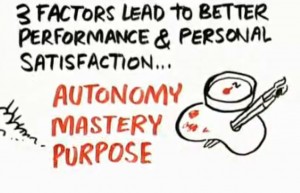
This TED talk by Dan Pink introduced me to the idea that, outside of income, there are three things we tend to look for in the world of work and more widely. These are (i) mastery (being good at the job), (ii) purpose (believing that what we do is worthwhile) and (iii) autonomy (being in charge of our agenda and, therefore, ultimately our levels of stress). Viewed through this lens, it became easier to make sense of my current job and my career path. For instance, I was able to understand that some of my current frustrations at work were down to a lack of mastery and autonomy, which may improve as I gain experience and build trust. I know I do not derive any purpose from my job and so I know that, in order to be happy, I will need to change career paths at some point. For each person, how much these things matter will differ, but the understanding ought to be useful.
The societal impact is also profound when we start to think about how to create a happier society. Should we re-evaluate the importance of income in motivation? Do all jobs allow us to achieve these elements? If not, do we change the nature of jobs? Or do we think about how people can achieve these things outside the world of work? Should we sacrifice more for full employment - as the workplace may be the only place where we can effectively achieve mastery, purpose and autonomy?
6. Connectedness

This is, in my mind, a self-evident idea. Having healthy, strong relationships and connecting on a regular basis; whether this be with family, life partners or friends is self evidently good for happiness. It allows us to verify our existence, partake in mutually beneficial activities, explore ideas, share life's burdens, confirm our altruistic nature and receive/give recognition, comfort and love.
One of my big disappointments in 2012 was that many of those close to me did not prioritise this source of happiness. Building strong relationships involves creating good "quality time". We all live busy lives so, in 2012, I gave serious though to events and spaces where I could connect with friends and family but people weren't able to make the time. My aim for 2013 is to continue with my perseverance and I am looking forward to revisiting some excellent memories in 2014!
